
Involuntary Institutionalization for the Disabled
An alarming new slip opinion from the Justice Department foretells where the Trump administration is attempting to head: privatizing homelessness.

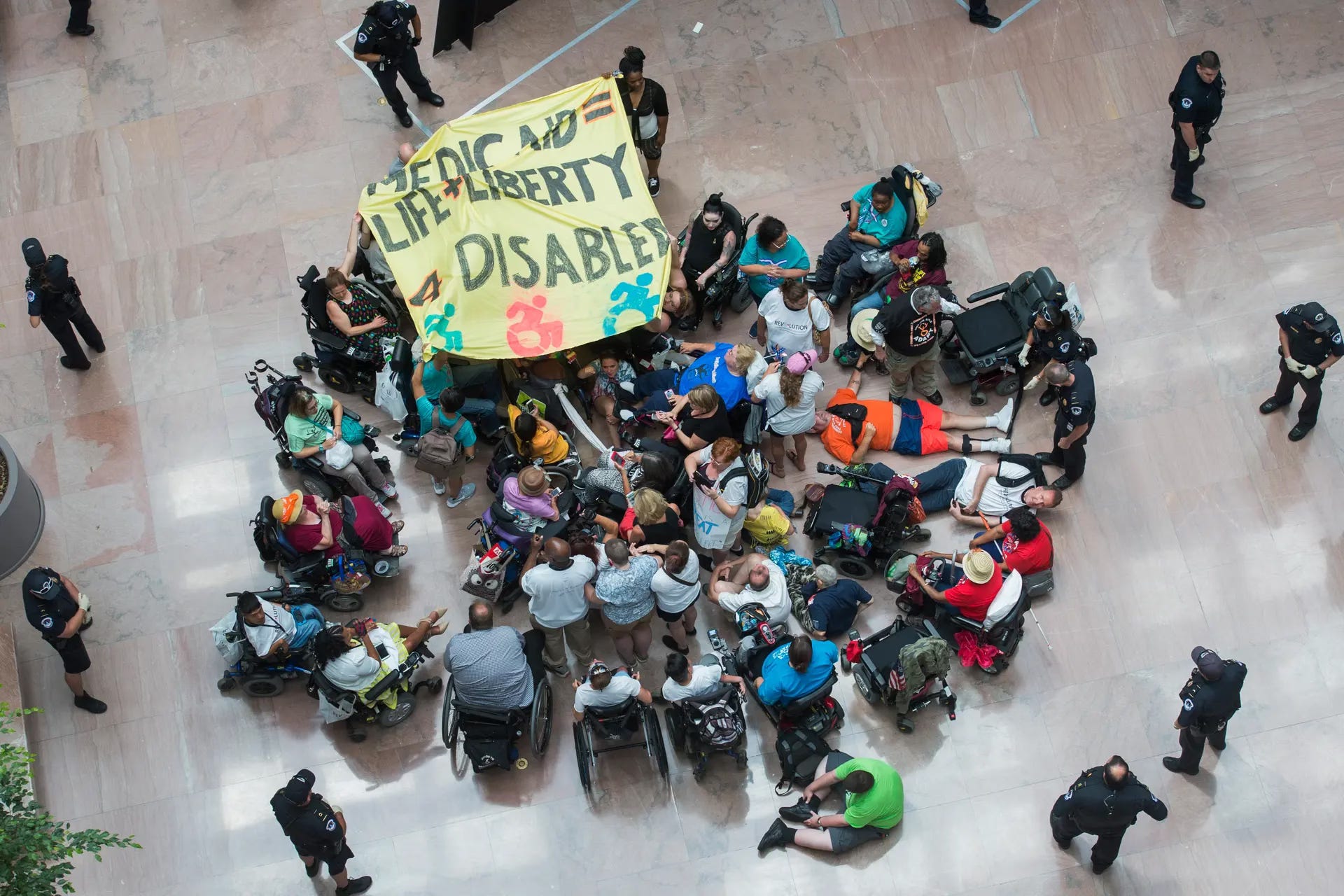
The Justice Department released an opinion from the Office of Legal Counsel this week that reflects the Trump administration’s intention to strip back more civil rights protections for Americans with disabilities, which have been in place for decades. The memo, which is a preliminary, standalone document containing a written legal interpretation issued by Department of Justice attorneys that is meant to guide the Executive Branch on complex constitutional and statutory questions, argues that states do not have to provide in-home or community-based care to people with disabilities who need support.
Both Section 504 of the Rehabilitation Act and Title II of the Americans with Disabilities Act have long been interpreted to require that states provide services to Americans with disabilities in the most integrated setting appropriate and that “institutionalization” should always be a last resort.
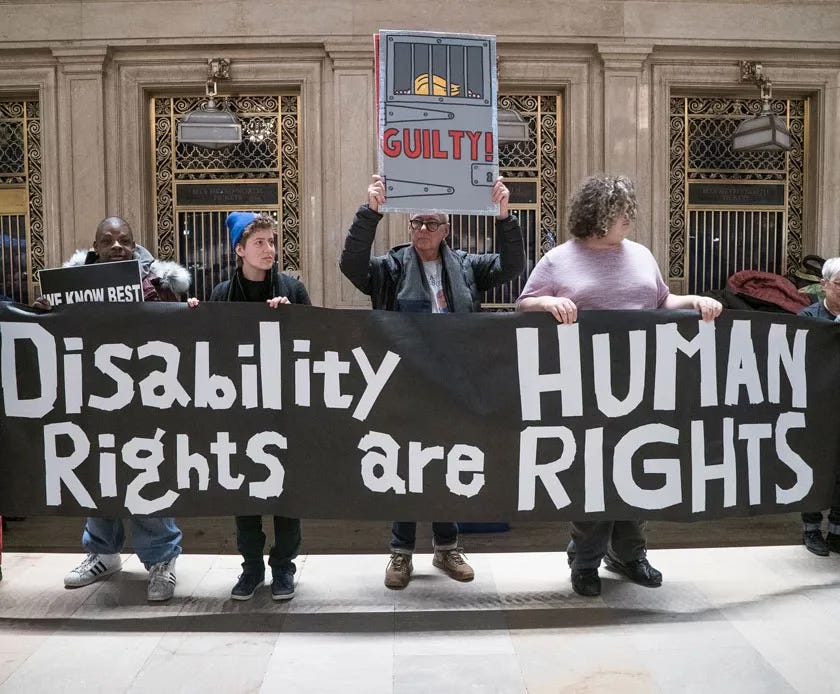
In 1999, Olmstead v. L.C., tested these well-established protections at the Supreme Court level, when two women with mental disabilities sued Georgia, arguing that the state had failed its obligation to provide services that would allow them to return to their communities and that it had continued to violate their Civil Rights by institutionalizing the women instead.
The US Supreme Court agreed that states have a legal responsibility to provide support that integrates disabled Americans into their communities, and for the last three decades, courts across the country upheld that interpretation. This new legal memo in question — drafted by Principal Deputy Assistant Attorney General in the Office of Legal Counsel Lanora Pettit — argues that federal law prohibits discrimination based on disability, but does not impose an “integration mandate” on states to provide these community services.
Pettit’s missive states that the Supreme Court’s Olmstead decision “held only that a state cannot institutionalize such patients without justification, [but] what counts as adequate justification remains an open question.” This memo also arrives as a new case, Texas v. Kennedy, is making its way through the courts, essentially serving as a conduit for challenging the integration mandate on states.
Last week, the Trump administration announced that the Special Education arm of the Department of Education would now be overseen by Health and Human Services Director Robert Kennedy, Jr. Based on how far this US Supreme Court is willing to strip away more well-established legal rights for those with disabilites, this next ruling out of Texas could carve out enough room for the Trump administration to make further strides in denying funding moving forward and creating a privatized institutional, setting much like prisons.
This memo has dropped as Republicans have also passed deep cuts to Medicaid, which is the primary source of funding for community-based services on which many disabled Americans rely. In 2023, 8.4 million Americans were receiving home and community-based services through Medicaid. The caveat in the federal disability law requiring home or community-based services first, whenever appropriate, remains a major obstacle to large-scale institutionalization of the unhoused.
A footnote in the Justice Department’s new memo (see below) argues these laws have “contributed” to the rise in chronic homelessness, rather than acting as a deterrent for Donald Trump to privatize institutions and sell the contract to the highest bidder. This Justice Department memo is just another piece of Trump’s bigger election promise to crack down on homelessness that began with an Executive Order on July 24, 2025, intended to make it easier for state and local governments to police the unhoused. Trump’s solution — involuntary institutionalization.
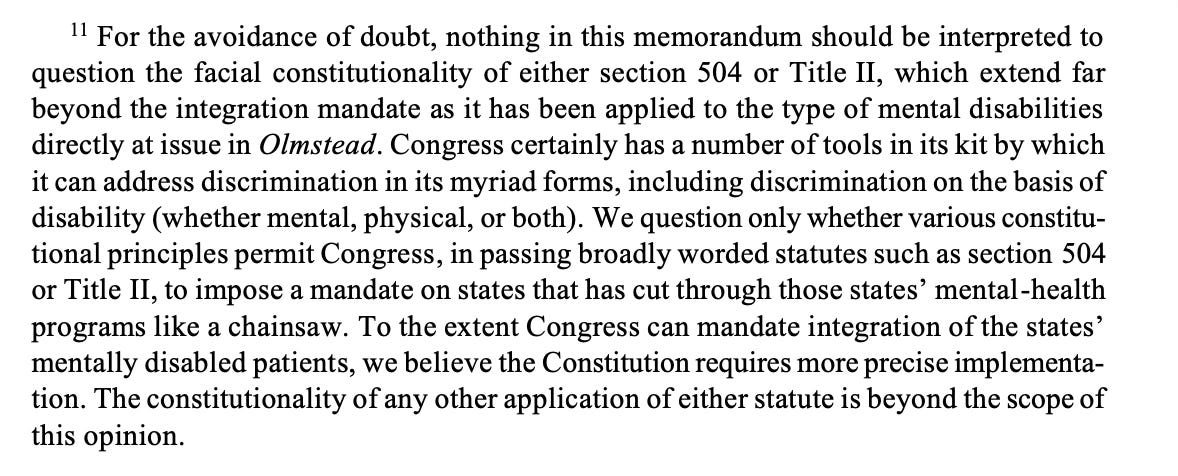
While this memo does not represent established law — Congress makes laws, not the Executive — it does give us a clearer sense of where the Trump administration will be headed next in its “Rollback of Rights and Profit Tour.” Despite setting up what appears to be a legal road map for the Department of Justice in moving forward, Pettit herself acknowledged that her legal theory may not be easily embraced by the courts, saying: “We recognize that this view of Olmstead‘s import is out of step with the common understanding of that decision within the federal courts.”
One thing remains clear: Donald Trump is removing any obstacles on his end by continuing to strip away agency employees, meant to help serve the unhoused and disabled communities. Now we have to wait and see if Donald Trump’s Supreme Court is willing to deliver on more Civil Rights violations by allowing Republicans to chip away further at established law.
Amee Vanderpool writes the SHERO Newsletter and is an attorney, published author, contributor to newspapers and magazines and analyst for BBC radio. She can be reached at avanderpool@gmail.com or follow her on Twitter @girlsreallyrule.
Paid subscriptions allow me to keep publishing critical and informative work that is sometimes made available to the public — thank you. If you like this piece and you want to further support independent journalism, you can forward this article to others, get a paid subscription if you don’t already have one or send a gift subscription to someone else today.
Amee, thank you for this piece. Something I simply do not understand from my perspective: a government so intent on criminalizing black and brown skinned people that they are happy to lock them up, starve, sicken, impregnate, abuse and kill them. Slow torture through multimillion dollar contracts with our government owned by billion dollar corporations. And now they have moved on to the handicapped population-because that’s what authoritarian regimes do. The cruelty is the point while a toddler in chief thumbs his nose at those facing infirmaries unimaginable. Unconscionable hatred for people just trying to get through each day.
We moved on from cruelty to immigrants and refugees and added in cruelty for the disabled