
Medicare Benefits Decreasing
Rising health care costs is always an issue, but the Senate's failure to pass legislation that covers the cost of ACA subsidies might be causing a disastrous decrease in services for seniors.


I just got into one of the most knock-down, drag-out phone fights with my mother, who is currently panicking over the state of her health insurance. To fully understand the tenor and crux of the dispute, let me quickly explain that my mother and I are both trained lawyers with drastically different approaches to deciphering and presenting information. My mother is a retired judge, but she never got the memo about stepping down from the bench when it comes to controlling any conversation or controversy.
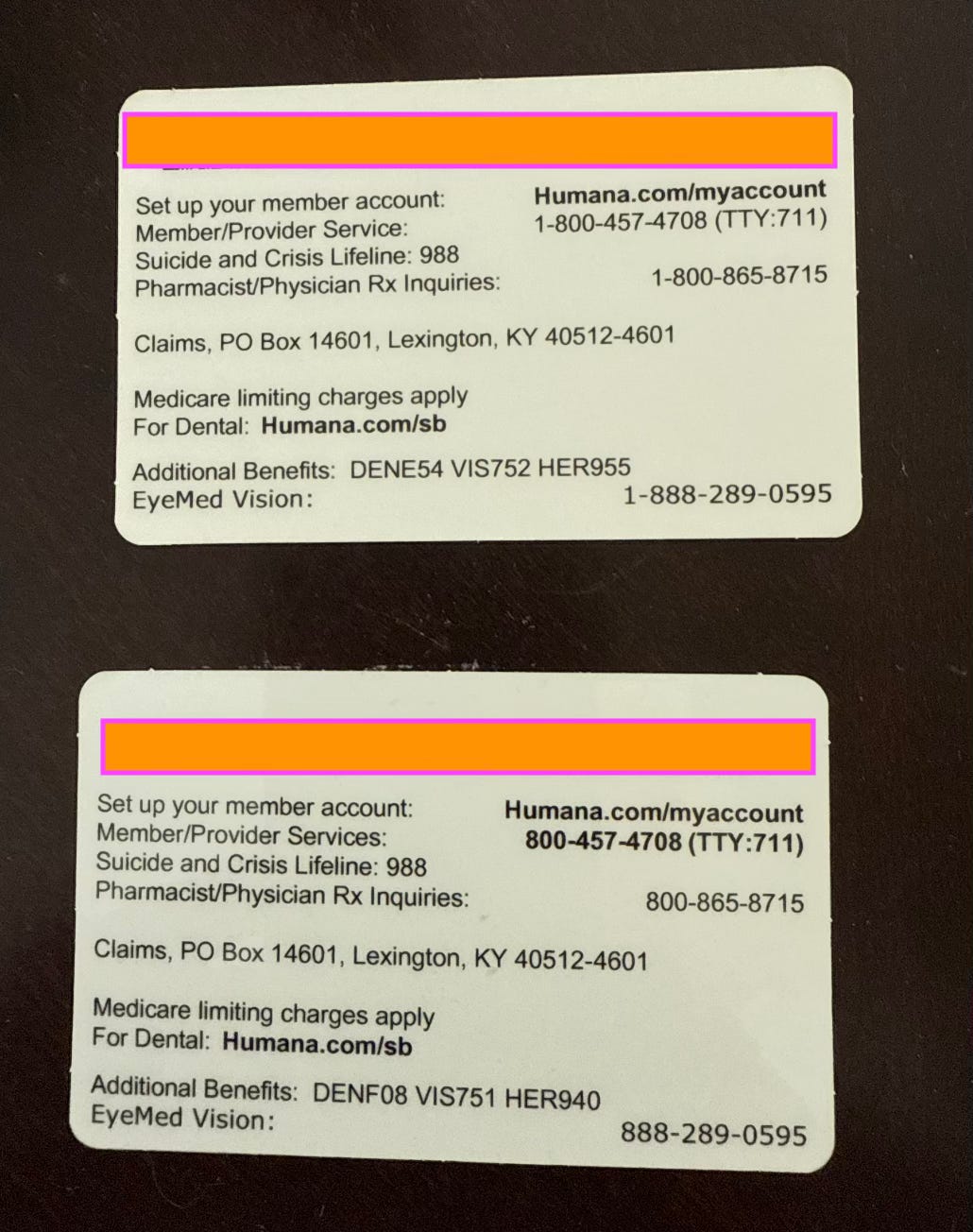
“I have something you need to write about.” This opening statement from my mother was the beginning of the end. She had just finished a phone call with her health insurance company and angrily tried to explain to me what was happening. I’m now going to save you some valuable time by weeding through our communication calamity to summarize the current issue for you. On the recent insurance card issued to my mother, the back lists three codes the insurance company uses to denote additional benefits.
Those numbers had changed, and when my mother called a representative to find out why, she was given no real explanation other than being told that those benefits for dental, vision, and hearing would be decreasing significantly. While my mother was able to confirm that all of those code changes denoted a decrease in her dental vision and hearing benefits, she was explicitly told that her additional vision maximum benefit for eyeglasses was decreasing from $250 to $75. There was nothing sent with the new cards to explain the new codes or the decrease in benefits. Any insurance customer would easily miss the change if they weren’t comparing the numbers with those listed from the previous year, which might be a tactic the health care company is relying on to help move medicaid recipients past any price increases and benefit decreases.
The ongoing battle over costs (and as a result, benefits) for the 2026 year of health insurance — which crippled Congress for weeks and caused a federal government shutdown — has still not been resolved, with only weeks to go until new insurance rates are due to apply to every health care customer in the United States. On November 14, 2025, the Centers for Medicare & Medicaid Services (CMS) released the 2026 premium rates, deductibles, and coinsurance amounts for Medicare Parts A and B, as well as the 2026 Medicare Part D income-related monthly adjustment amounts.
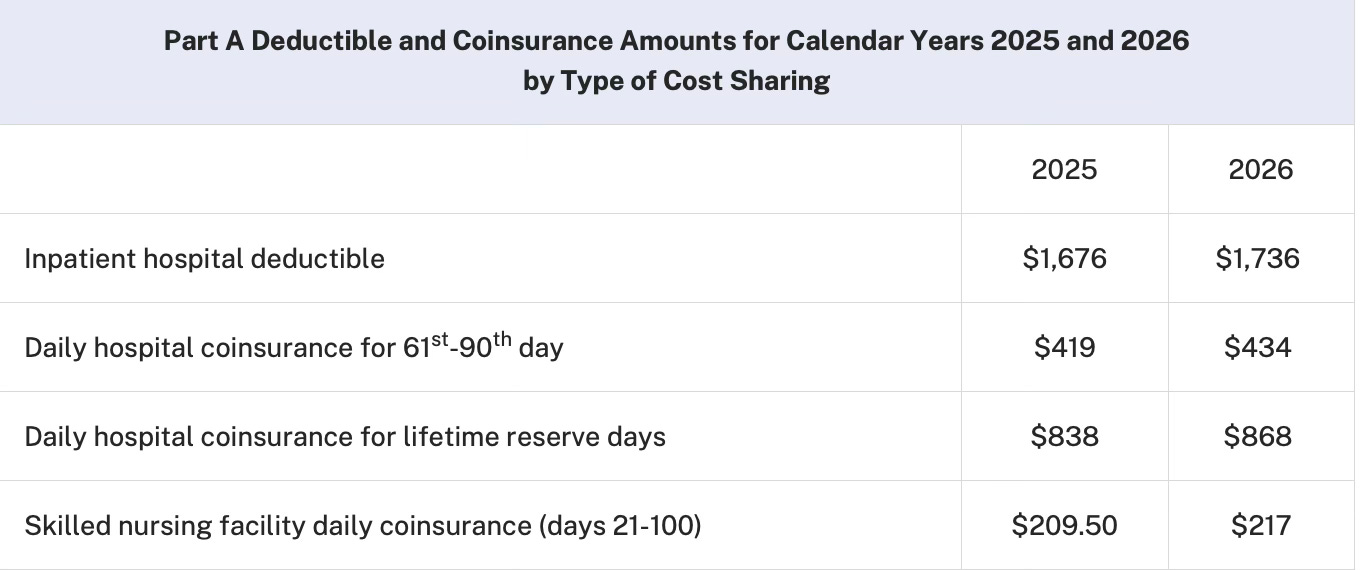
The following excerpt and graphic from CMS below is meant to break down all of the rising costs for the next year:
“The Medicare Part A inpatient hospital deductible that beneficiaries pay if admitted to the hospital will be $1,736 in 2026, an increase of $60 from $1,676 in 2025. Part A inpatient hospital deductible covers beneficiaries’ share of costs for the first 60 days of Medicare-covered inpatient hospital care in a benefit period. In 2026, beneficiaries must pay a coinsurance amount of $434 per day for the 61st through 90th day of a hospitalization ($419 in 2025) in a benefit period and $868 per day for lifetime reserve days ($838 in 2025). For beneficiaries in skilled nursing facilities, the daily coinsurance for days 21 through 100 of extended care services in a benefit period will be $217.00 in 2026 ($209.50 in 2025).”
While Congress continues in a stalemate over how they plan to fund several aspects of health insurance subsidies that were struck down by Trump’s “Big Beautiful Budget,” it is clear that health insurance companies, including Medicaid, are not being crystal clear on where price hikes will occur specifically, and how those costs will be passed on to the consumer exactly. While this typically happens every year based on projections of health care cost increases, those fees are not usually expected to rise by more than a certain percentage, and insurance buyers have come to expect that level of pricing fluctuation.
A majority of Medicare plans come with no monthly premiums, which is a significant draw for seniors, even though increases still cost taxpayers more. While Medicare beneficiaries were projected to see a 10% increase next year to brace for higher costs, the uncertainty in the actual rise of the expenses to the consumer is still based on projections, thanks to the lack of Congressional movement on passing a bill that fully funds health insurance at least to the level that it was funded in 2025. On November 17, a bipartisan group of 30 House Republicans and Democrats sent a letter to Senate Majority Leader John Thune (R-SD) and Senate Minority Leader Chuck Schumer (D-NY), urging them to include House members in negotiations ahead of the promised health care vote in December to address the expiring Affordable Care Act (ACA) premium tax credits.
The ongoing problem remains: until Congress passes a law that addresses how the government will fund health care subsidies under the Affordable Care Act (ACA), everyone, including Medicare recipients, can expect their benefits to dwindle to compensate for rising costs and a lack of government funding. Senate Democrats are now looking to propose a three-year extension of the Affordable Care Act subsidies, which are set to expire soon, for an expected floor vote next week.
As part of a deal struck with Senate Majority Leader John Thune last month to end the government shutdown a few weeks ago, Democrats will get to propose the terms for funding the subsidies in a vote expected on December 11. According to two people granted anonymity to discuss Democratic Caucus strategy, Democrats plan to propose a three-year extension of the Affordable Care Act subsidies, set to expire soon, for a floor vote next week. But Thune confirmed in an interview on Wednesday that Democrats’ plan to pitch a clean three-year extension is “designed to fail.”
To pass a funding bill on subsidies in the US Senate, it will require 60 votes in favor. Republican Senators, including Susan Collins (ME), Lisa Murkowski (AK), and Thom Tillis (NC), have publicly backed the idea of a two-year extension, but have also warned that there will need to be income caps and other provisions, such as additional abortion funding restrictions, to get the necessary support from the remainder of Republican Senators. If Democrats move forward with a basic plan that extends ACA subsidies for 3 years with no other caveats, Republicans will ensure the vote fails. Until Congress determines a way to pay for the ACA subsidies, no one’s health care costs are easily calculated or safe, as exorbitant cost increases are extended to all health insurance customers.

As we move toward that doomed Senate vote, now would be a great time to check your health insurance identification cards, which insurers recently mailed to most customers recently. These cards, which usually denote the final agreement between the health insurer and the client, can only be seen as “projections” for health care costs next year, and those numbers are already not adding up.
Suppose you are a health insurer trying to sell a 10% increase to a Medicare customer for an impending contract, given the current uncertainty and expected rise in medical industry costs. In that case, that number should be accurately represented somewhere, with an explanation of how those costs were calculated. Sending seniors a new insurance card that changes medical codes on the back of the card, with no explanation of how that fee is justified, is an advantage that no party should have over another in a contract.

One thing we can decipher at this point is that my mother’s medical benefit decreased by roughly 66%, with no real notice or explanation of the change or how it was calculated, and that number in no way reflects a 10% rate increase. Now would be a great time to compare the card you were just sent for this year with the one you have from last year to see what has fundamentally changed in your contract. Your insurance company should be able to readily explain how it is attempting to justify any increases or decreases in your coverage that result in a loss to you.
Next, you need the local office phone number for your US Senator to get ready to contact them directly on November 11 if the next vote to extend ACA subsidies fails. One thing we know for sure at this point is that all new health insurance cards are merely projections for costs next year, as it is impossible to accurately calculate these costs until an ACA subsidy agreement is passed. Until the Senate determines how Congress will extend the ACA subsidies for next year, no one can accurately calculate what kind of health insurance they will have in 2026, or how much that coverage will cost.
Amee Vanderpool writes the SHERO Newsletter, is an attorney, published author, contributor to newspapers and magazines, and an analyst for BBC radio. She can be reached at avanderpool@gmail.com or follow her on Twitter @girlsreallyrule.
Paid subscriptions and one-time tributes embedded in each article allow me to keep publishing critical and informative work that is sometimes made available to the public — thank you. If you like this piece and want to support independent journalism further, you can forward this article to others, get a paid subscription or gift subscription, or donate as much as you like today.
Thank you, Amee. The level of incompetence, plain and simple selfishness and arrogance that these US Senators show is galling. Ridiculous. And then this is your mom who is sharp and on top of matters. These U.S. Senators and U.S. Representatives get the absolute best gold standard healthcare that is offered and it is heavily subsidized. They are paid $174K per year with U.S. Senators Grassley, Schumer, and Thune each earning $193,400 per year as President pro tempore, Senate minority and Senate majority leaders respectively. The taxpayers are paying their salaries, and yet they are shafted with a radical 66% drop in coverage. Unbelievable. Thank you for bringing this up to everyone’s attention, Amee! Why is healthcare not considered a human right in the United States, and why are girls and women not uniformly provided proper healthcare rights, bodily autonomy and reproductive rights?
Wow...not even subtle that my cohort is now expendable.